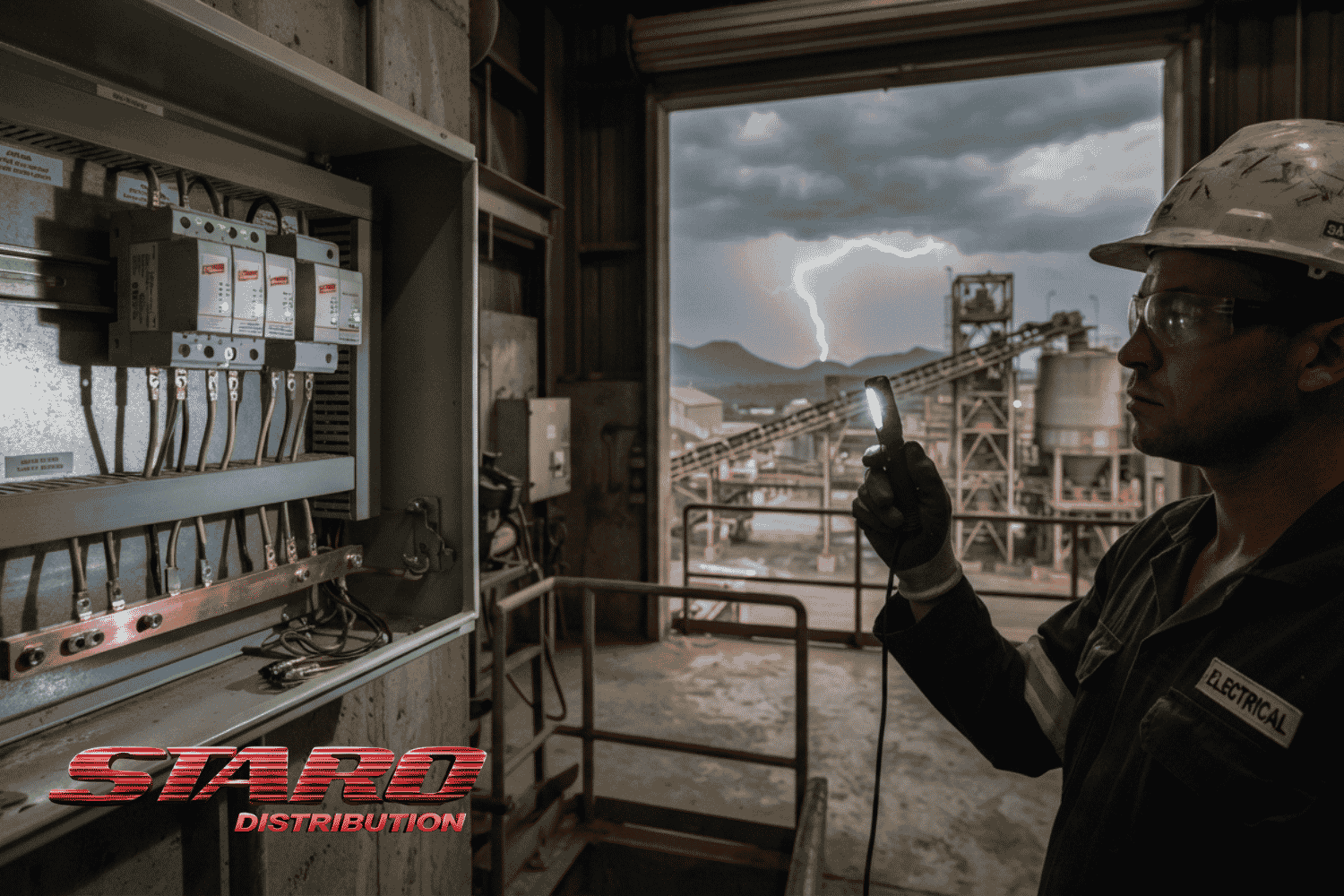

Quick Answer: How Do You Plan Surge Protection for Mining, Agriculture and Processing Sites?
Surge protection planning for industrial and rural sites uses a layered, three-stage approach: Type 1 surge protective devices (SPDs) at the main incomer to handle lightning currents, Type 2 SPDs at distribution boards and motor control centres (MCCs) to absorb residual and switching surges, and Type 3 protection close to PLCs, instrumentation and communication equipment. The plan rests on a lightning risk assessment under SANS 62305-2, a low-resistance earthing and bonding system, protection for data and signal lines, short SPD connection leads and routine inspection.
Staro Distribution, an authorised SineTamer distributor, supplies SineTamer surge protection for service entrances, distribution boards, control panels and data circuits from its Sasolburg and Secunda branches, alongside the Allen-Bradley equipment those devices protect.
By Ninya Claassen, TLDC Marketing
Published: 2 November 2026
Surge damage is rarely a single dramatic event. More often it shows up as a drive that trips for no clear reason, a PLC input card that fails after a storm, or a borehole pump controller replaced for the third time in a season. Mining, agricultural and processing sites are particularly exposed because they combine long cable runs, tall or isolated structures, large motor loads and sensitive electronics on the same electrical system.
South Africa’s lightning exposure adds to the risk. According to the South African Weather Service’s lightning climatology, southern Gauteng and the northern and north-eastern Free State average 10 to 15 ground flashes per square kilometre per year, with densities above 15 along the Northern Drakensberg escarpment. That band covers much of the Vaal Triangle’s industrial base, where Staro’s Sasolburg head office is located.
This guide sets out how to plan surge protection in the right order, what changes between site types, and the installation details that decide whether a surge protective device works when it is needed.
Step 1: Start With a Lightning Risk Assessment and the Relevant Standards
Surge protection planning should start with a lightning risk assessment, because the result determines which SPD types the site needs and where.
In South Africa, the main references are:
- SANS 62305 (aligned with IEC 62305): lightning protection of structures. Part 2 sets out the risk assessment and Part 4 covers protection of internal electrical and electronic systems.
- SANS 10313: the national lightning protection standard, which applies SANS 62305 and requires conductive cables entering protected spaces to be surge protected and bonded.
- SANS 10142-1: the wiring code. Industry guidance on the code states that a Type 1+2 device is required where a structure has an external lightning protection system, and that at least a Type 2 device is recommended where it does not.
- SANS 61643-11 (IEC 61643-11): the test standard for low-voltage SPDs, which defines the Type 1, 2 and 3 classes.
The risk assessment considers ground flash density, structure height and size, how isolated the site is, incoming services and the consequences of failure. A remote borehole and a plant control room may sit on the same farm or mine but need very different protection.
Step 2: Get Earthing and Bonding Right First
An SPD can only divert surge energy if it has a low-impedance path to earth. Without effective earthing and bonding, even the best device cannot protect the equipment behind it.
Practical requirements include:
- Soil resistivity testing before designing the earth electrode system, particularly on rocky mine sites and dry rural ground where resistivity can be high.
- Equipotential bonding of structural steel, conveyor frames, pipelines, cable trays and equipment enclosures, so that a lightning strike raises everything to the same potential instead of driving current through electronics.
- Bonding of incoming services, including power, signal and metallic water lines, at the point where they enter a structure.
- Periodic earth resistance testing, because corrosion, construction work and drying soil all degrade an earth system over time.
Step 3: Apply the Three-Stage Cascade of Type 1, Type 2 and Type 3 SPDs
A cascaded design places progressively finer protection closer to sensitive equipment, so that each stage reduces the surge energy left for the next.
The stages follow the lightning protection zone (LPZ) concept in SANS 62305-4: each SPD sits at the boundary where cables pass from a more exposed zone into a better-protected one.
| Stage | Where it is installed | What it handles | Typical site examples |
|---|---|---|---|
| Type 1 | Main incomer or service entrance | Partial direct lightning currents (10/350 µs) entering from outside | Plant main distribution board, substation feed, farm main supply |
| Type 2 | Sub-distribution boards and MCCs | Induced lightning surges and internal switching transients (8/20 µs) | MCCs feeding crushers, conveyors, pumps and VSD panels |
| Type 3 | Close to sensitive end equipment | Residual surges reaching electronics | PLC and control panels, SCADA, RTUs, instrumentation |
Many industrial transients are generated inside the plant rather than by lightning. Contactors, large motor starts and variable speed drives all produce repetitive switching transients that a Type 2 stage at the MCC is well placed to absorb. Staro’s article on SineTamer VSD protection explains how this supply-side protection reduces nuisance trips in drive panels.
Where Staro Distribution fits: SineTamer covers each stage of the cascade. High-capacity SineTamer Advantage units, rated from 90 kA up to 900 kA per phase, suit service entrances. The SineTamer LA-ST and RM-ST series suit distribution boards, MCCs and control panels; the LA-ST is UL 1449 4th Edition Type 2 listed, with a Type 1 version available. Frequency-attenuation models also reduce lower-energy, high-frequency disturbances that conventional clamping devices let through.
Mining and Mineral Processing Sites
Mines combine the highest lightning exposure with the most expensive consequences of downtime.
- Exposed structures: headgears, processing plant towers, stockpile conveyors, draglines and ventilation shafts act as lightning attachment points. Their steelwork must be bonded so that strike currents do not flow through control cabling.
- Harsh environments: dust, moisture, vibration and heat mean SPDs should be mounted inside suitably rated enclosures or within the panels they protect, with enclosure ratings matched to the location.
- Dense motor loads: MCCs feeding crushers, mills and conveyors generate internal switching transients continuously. Protecting drive panels at the supply side complements the power-quality measures covered in Staro’s guide to common VFD failure causes and how to reduce downtime.
- Dewatering and remote pumps: pumps at pit sumps and remote stations sit at the end of long feeders and are frequent surge casualties. Staro Distribution supplies Tsurumi submersible pumps for these duties, and protecting their supply and control circuits is part of keeping them in service.
For plants built on Allen-Bradley ControlLogix, PowerFlex and Stratix equipment, surge protection is part of the same reliability plan as spares and lifecycle support. See Rockwell Automation for mining and heavy industry plants.
Agricultural and Irrigation Sites
Farms face a different risk profile: long cable runs across open ground, weak rural supply and growing use of solar power.
- Long outdoor runs: submersible pumps, centre pivots and weather stations often sit hundreds of metres from the main supply. Long overhead or buried cables collect induced surges from nearby strikes, so protect both the feed at the distribution point and the controller at the remote end.
- Rural power quality: rural networks commonly experience voltage sags, swells and phase imbalance. SPDs do not correct these. Pair surge protection with under-voltage and phase-failure protection for motors, so pumps are not damaged by running on a weak or missing phase.
- Solar and hybrid systems: where a farm or packhouse uses solar PV, the DC side (PV strings and inverter inputs) and the AC output both need SPDs rated for their voltage and current type. A standard AC device is not suitable on a DC string.
- Remote monitoring: pump and pivot telemetry is especially vulnerable to surges carried along long copper signal cables.
Processing Plants
In food, beverage, chemical and water treatment plants, lightning is often less of a threat than the plant’s own switching activity.
These sites run large numbers of VSDs, PLCs and networked instruments from shared MCCs. Every contactor operation and drive switching event introduces transients that age electronic components over time, often without any visible single event. Type 2 protection at each MCC and Type 3 protection at control panels address this directly. It also supports the reliability and uptime priority discussed in Staro’s article on the 5 priorities defining manufacturing’s next chapter.
Protect Data, Signal and Communication Lines
A surge does not need to arrive on the power cable. RS-485, Ethernet, fieldbus and 4–20 mA signal cables can all carry surge energy into PLCs and SCADA equipment.
- Protect signal lines at both ends where they run between buildings or to field equipment.
- Bond the earth of signal-line SPDs to the same earthing system as the power SPDs, so the two are not at different potentials during a strike.
- Consider replacing long copper runs between structures with fibre optic or industrial wireless links, which remove the conductive path entirely.
Where Staro Distribution fits: SineTamer protection is available for control system and data and telecoms circuits as well as AC and DC power. For remote pumps and field stations, Staro Distribution also supplies Prosoft industrial wireless and remote-access products, which can replace long copper signal runs.
Installation Rules That Decide Whether an SPD Works
A correctly rated SPD can still fail to protect equipment if it is installed with long leads or undersized conductors.
- Keep leads short: industry guidance on SANS 10142-1 states that the total connection length from the live or neutral terminal to the earth bar should not exceed 0.5 m. Every extra centimetre adds inductive voltage that reaches the protected equipment.
- Use the correct conductor size: the same guidance gives a minimum of 6 mm² copper for Type 2 devices and 16 mm² copper for Type 1+2 devices.
- Protect every conductor: install protection from live to earth and from neutral to earth. Fitting live-to-earth only is a common error.
- Route conductors cleanly: avoid loops, slack wire and sharp 90° bends.
- Mount close to the protected point: SPDs designed to install inside the panel or equipment disconnect give the shortest possible leads.
Maintenance: Keeping Surge Protection Effective
SPDs are sacrificial devices. Each surge they absorb uses up some of their capacity, so they must be inspected rather than installed and forgotten.
- Check status indicators as part of routine inspections and after every significant storm.
- Use surge counters on critical boards to see how often a site is being hit. Optional surge counters are available on SineTamer units.
- Disconnect SPDs before insulation resistance (Megger) testing, because the test voltage can damage the device or give false readings.
- Retest the earth system periodically and after civil or excavation work near earth electrodes.
- Keep spares for critical boards, so a device at end of life can be replaced immediately instead of leaving the board unprotected.
Surge Protection Planning Checklist
- Complete a lightning risk assessment under SANS 62305-2.
- Test soil resistivity and confirm the earthing and bonding design.
- Map every incoming power, signal and metallic service.
- Place Type 1, Type 2 and Type 3 SPDs at the zone boundaries.
- Add protection for DC solar circuits and data lines.
- Install with leads under 0.5 m and correctly sized conductors.
- Schedule inspections, earth tests and SPD spares.
Surge Protection Supply and Support From Staro Distribution
Staro Distribution is an authorised SineTamer supplier serving mining, industrial and agricultural operations across Southern Africa, and an Authorised Value-Add Distributor for Rockwell Automation. That combination means the surge protection and the equipment it protects can be specified together:
- SineTamer Advantage, LA-ST and RM-ST units for service entrances, distribution boards, MCCs and control panels.
- SineTamer protection for DC, control and data circuits, including telecoms and signal lines.
- Allen-Bradley PowerFlex drives, PLCs and HMIs, the equipment most often damaged by surges. See compact PowerFlex drives compared.
- Prosoft industrial wireless and Tsurumi submersible pumps for remote and dewatering applications.
Product specialists help size SPDs for supply voltage, star or delta configuration and exposure level, and stock held at the Sasolburg and Secunda branches shortens replacement time after a storm. For the wider case for local support, see why local Rockwell Automation support matters for uptime.
Planning surge protection for a new site or tired of replacing equipment after every storm season? Contact Staro Distribution or email sales@staro.co.za to size the right SineTamer protection for your site.
Frequently Asked Questions (FAQs)
1. What is the difference between Type 1, Type 2 and Type 3 surge protective devices?
Type 1 SPDs are installed at the main incomer and are tested to handle partial direct lightning currents (10/350 µs waveform). Type 2 SPDs are installed at distribution boards and MCCs to handle induced and switching surges (8/20 µs waveform). Type 3 devices are installed close to sensitive equipment to limit any residual surge. Used together, they form a cascade that reduces surge energy in stages.
2. Is surge protection required in South Africa?
Industry guidance on the SANS 10142-1 wiring code states that a Type 1+2 SPD is required where a structure has an external lightning protection system, and that at least a Type 2 SPD is recommended where it does not. A lightning risk assessment under SANS 62305-2 determines the level of protection a site needs.
3. How long can surge protector connection leads be?
Guidance on SANS 10142-1 states the total conductor length from the live or neutral terminal to the earth bar should not exceed 0.5 m. Longer leads add inductive voltage that passes to the protected equipment, reducing the SPD’s effectiveness.
4. Do surge protectors protect against voltage sags or phase imbalance?
No. SPDs limit short transient overvoltages such as lightning and switching surges. Voltage sags, swells and phase imbalance, common on rural networks, need under-voltage and phase-failure protection, ideally installed alongside surge protection.
5. How often should surge protection be inspected?
Check SPD status indicators during routine maintenance and after every significant storm, and retest the earthing system periodically. Disconnect SPDs before insulation resistance (Megger) testing, and keep spares for critical boards so end-of-life devices can be replaced immediately.
6. Who supplies SineTamer surge protection in South Africa?
Staro Distribution, part of Staro Process Control, is an authorised SineTamer distributor serving mining, industrial and agricultural sites across Southern Africa from branches in Sasolburg and Secunda. Its product specialists help select and size SineTamer units for each stage of a site’s protection plan.
ELECTRICAL, CONTROL & INSTRUMENTATION PRODUCTS
Control Systems
– By Allen Bradley
- Programmable Controllers (PLC)
- Industrial Safety
- Condition Monitoring
- Industrial Computers & HMI
- Variable Speed Drives
- Soft Starters
- MV Drives & Soft Starters
- Power Monitoring
- Industrial Low Voltage Control Gear
Connectivity, Upgrade &
Migration – By Prosoft
- Remote Access
- Gateways
- Industrial Wireless
- Rockwell in Chassis
- Schneider in Chassis
- Siemens in Chassis
Surge Suppression
– By SineTamer
We are an Authorised Distributor for SineTamer products and solutions managing the quality of electrical power to devices and protecting the following circuits.
- AC & DC Circuits
- Control System Circuits
- Data & Telecoms Circuits
- 525V and 690V Volts
- Medium Voltage
Flow Meters
– By UPC
Electromagnetic Flow Meters
Turbine Flow Meters
Vortex Flow Meters
Ultrasonic Flow Meters
Woltman Type Water Meters
Water Meters
Analyzer
Dosing Pump
MECHANICAL PRODUCTS & SOLUTIONS
We supply and service the Valve, Pump and Pneumatics market from our various global partners.
Pumps
- Submersible
- End Suction, In Line
- Vertical Turbine
- Slurry Pumps
Valves
- Steam Traps
- Forged with extended Bonnets
- Knife, Butterfly & NVRV
- Gate, Globe, Check & Ball
- Cryogenic
- Control Valves
- Safety Valves
- Boiler valve solutions
We are also the sole South African distributor of NSV valves.
Pneumatics
- Cylinders, Regulators & Solenoid Valves
- Tubing, Fittings & Connectors
- Air Drying Solutions









HEAD OFFICE

17 Venus Street, Sasolburg, 1947

+27 (0)16 971 3333
SECUNDA BRANCH
16 Steenkamp Street, Secunda, 2302
+27 (0)17 634 7011

sales@staro.co.za


