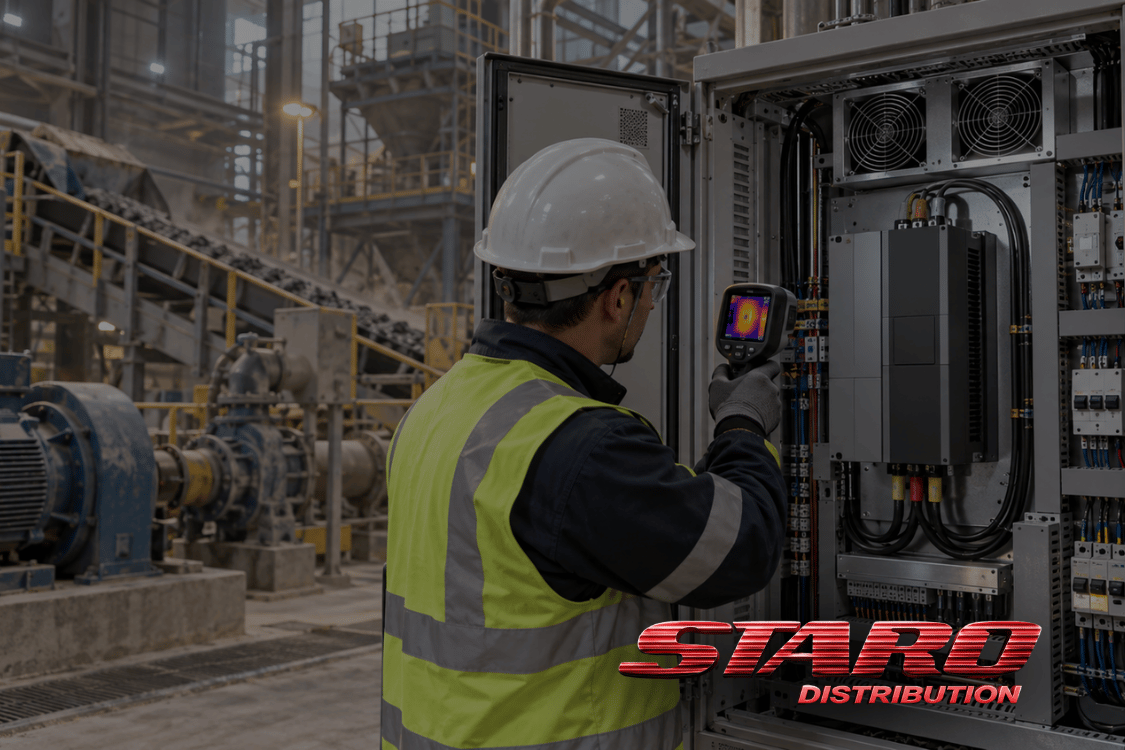

Quick Answer: What Causes VFD Failures?
Common VFD failure causes include overheating and blocked cooling airflow, dust and moisture contamination, poor power quality and harmonic distortion, loose electrical connections, VFD-induced shaft currents that damage motor bearings, incorrect drive sizing or configuration, excessive mechanical loads, and ageing internal components.
Plants can reduce VFD-related downtime through proper environmental control, power-quality protection, shaft grounding on inverter-duty motors, routine electrical and insulation inspections, correct parameter settings, and condition-based maintenance.
Variable Frequency Drives are critical to the operation of pumps, fans, conveyors, crushers, compressors, and other motor-driven equipment across mining, manufacturing, and process plants.
When a VFD trips repeatedly or fails completely, however, the immediate assumption is often that the drive itself is faulty. That is not always the case.
A drive fault can originate from the electrical supply, motor, cabling, mechanical load, operating environment, control configuration, or the VFD itself. Understanding these potential causes allows maintenance teams to investigate the complete motor-control system rather than repeatedly resetting or replacing equipment without resolving the underlying problem — a difference that can significantly reduce avoidable downtime on plants where motor-driven equipment is directly linked to production.
1. Overheating and Environmental Contamination
Heat is one of the most important factors affecting VFD reliability. Variable frequency drives generate heat during normal operation and depend on adequate ventilation, cooling fans, and clean airflow paths to maintain acceptable internal temperatures. At the same time, dust, conductive particles, oil, moisture, and corrosive contaminants can restrict that cooling, trap heat, accelerate corrosion, and create tracking or arcing paths on circuit boards.
Problems typically begin when:
- Air filters become blocked with dust
- Cooling fans deteriorate or fail
- Cabinet ventilation is restricted or panels are installed close to other heat-producing equipment
- Ambient plant temperatures become excessive
- Dust, oil, or moisture accumulate around heatsinks and circuit boards
Rockwell Automation specifically identifies air-filter obstruction as an important cause of poor cooling airflow on PowerFlex 6000 drives and notes that insufficient cooling can result in overtemperature alarms or trips (Rockwell Automation). This is particularly relevant in mining, minerals processing, cement, manufacturing, and other dusty industrial environments, where the operating environment should form part of the drive-selection process, not only the maintenance programme.
How to reduce overheating-related downtime
Inspect cooling fans, filters, and ventilation paths as part of the plant’s preventative maintenance programme. Any abnormal temperature rise, unusual fan noise, or repeated overtemperature alarm should be investigated rather than continually reset — Rockwell’s maintenance guidance recommends checking fan assemblies for dirt, damage, and restricted rotation, since blocked or dirty fans can ultimately contribute to component damage or failure (Rockwell Automation).
2. Loose Electrical Connections
Industrial equipment experiences continual heating, cooling, and vibration. Over time, these conditions can loosen connections in incoming power terminals, motor connections, earth connections, control wiring, terminal blocks, bus connections, and associated MCC equipment.
A deteriorating connection creates resistance and additional heat, and can eventually result in unstable operation, arcing, nuisance trips, or damage to connected equipment. Simply looking at a connection may not reveal the problem, which is why maintenance procedures should include appropriate electrical inspection, thermographic testing where applicable, and torque checks performed to manufacturer requirements. Rockwell’s PowerFlex preventative-maintenance guidance includes checking the tightness of accessible power and cooling connections as part of scheduled maintenance (Rockwell Automation).
3. Poor Power Quality and Harmonic Distortion
Not every VFD fault starts inside the drive cabinet. Industrial power systems can experience voltage spikes, dips or sags, supply imbalance, transient events, harmonic distortion, switching disturbances, and lightning-related surges. These conditions can trigger drive faults and place additional stress on the drive and connected motor system — a DC bus overvoltage fault, for example, can occur when the motor regenerates energy back into the drive during rapid deceleration.
This means repeatedly replacing a drive will not solve the problem if the true cause is the incoming supply or application behaviour. Plants experiencing recurring electrical faults should investigate the broader electrical system rather than looking exclusively at the VFD. Where supply conditions are genuinely poor, line reactors or isolation transformers are the standard engineering response — they add impedance ahead of the drive to smooth voltage transients and reduce harmonic distortion before it reaches the rectifier and DC bus.
4. VFD-Induced Shaft Currents and Bearing Damage
VFDs control motor speed by rapidly switching the output voltage on and off — a technique called pulse width modulation. This fast switching creates a fluctuating “common mode” voltage that induces a small voltage on the motor shaft itself. Left unmanaged, that shaft voltage builds up until it discharges through the motor bearings to reach ground.
Industry literature on the subject describes this discharge as an electrical-discharge-machining effect: each pulse leaves a microscopic pit in the bearing race, and repeated discharges eventually produce a “fluted” groove pattern that leads to premature bearing failure (Pumps & Systems). Because the damage accumulates gradually, it is often mistaken for a normal mechanical bearing failure rather than an electrical one.
This risk is highest on larger inverter-duty motors and is managed through:
- Shaft grounding rings, which give the induced current a low-resistance path to the motor frame instead of the bearing
- Insulated bearings, typically on the non-drive end of larger motors
- Common-mode chokes or filters at the drive output, on more severe cases
Specifying this protection at the motor and drive selection stage is far more cost-effective than replacing a motor after fluting has already set in.
5. Incorrect Acceleration and Deceleration Settings
Modern VFDs allow engineers to precisely control how quickly motors accelerate and decelerate, and incorrect settings can create unnecessary faults. An excessively aggressive acceleration time can require high current to bring a heavily loaded motor to speed, while rapid deceleration can cause regenerative energy from the rotating equipment to increase the drive’s DC bus voltage.
The correct ramp depends on the application — a conveyor carrying material behaves very differently from a lightly loaded fan. Rather than simply increasing fault limits or repeatedly resetting the drive, the motor data, application load, and drive parameters should be reviewed together.
6. Mechanical Overload or Binding
One of the most important troubleshooting principles is that a VFD overcurrent or overload fault does not automatically mean the VFD has failed — the connected equipment may simply be demanding more torque than expected.
Potential causes include conveyor jams, seized bearings, pump blockages, material build-up, damaged gearboxes, misalignment, excessive friction, unexpected increases in process load, and mechanical equipment starting under load. EMC’s troubleshooting guidance similarly identifies mechanical binding and unexpected process loads as potential contributors to high current conditions (Energy Management Corporation) — which is why effective VFD troubleshooting needs input from both electrical/automation and mechanical maintenance teams.
7. Incorrect VFD Selection or Application
Even a perfectly healthy VFD can experience reliability problems if it was incorrectly selected. Drive selection should consider more than motor kW — engineers may need to assess motor full-load current, supply voltage, constant or variable torque requirements, starting torque, duty cycle, overload requirements, motor cable length, environmental conditions, control architecture, regenerative requirements, and safety requirements.
For demanding conveyors, crushers, mills, or high-inertia loads, correct drive selection and engineering become particularly important — this is where working with an experienced PowerFlex drive supplier and system integrator adds value beyond simply purchasing the hardware.
8. Ageing Fans, Capacitors, and Electronic Components
VFD components do not have an unlimited service life. Cooling fans, capacitors, and other internal components gradually age according to operating hours, temperature, loading, and environmental conditions. Waiting for these components to fail before taking action effectively converts a predictable maintenance requirement into an emergency breakdown.
PowerFlex platforms can support preventative and predictive maintenance strategies, with certain systems providing information about component condition and remaining life. Rockwell recommends scheduled preventative maintenance for applications requiring high machine availability (Rockwell Automation), which complements Staro’s existing approach to PowerFlex drive lifecycle support rather than treating VFD maintenance as an isolated repair activity.
How to Reduce VFD-Related Downtime
A practical VFD maintenance programme should be based on the drive manufacturer, application, and operating environment rather than a generic checklist, but the following areas apply across most industrial installations:
- Cooling fans, air filters, and cabinet ventilation
- Dust, moisture, or corrosion around heatsinks and boards
- Terminal and power connection tightness, checked with a calibrated torque tool
- Shaft voltage and bearing condition on inverter-duty motors
- Insulation resistance on motor cables and windings, tested periodically with a megohmmeter and logged over time to catch degradation before a hard short occurs
- Acceleration and deceleration parameters, matched to the actual load
- Incoming power quality, with line reactors or isolation transformers where supply conditions warrant it
- Fault history — a drive that occasionally records an overtemperature or overvoltage alarm before eventually tripping completely has already provided information that could have been acted on earlier
PowerFlex drives should also be treated as diagnostic assets, not simply motor-speed controllers. Data such as motor current trends leading up to a trip, whether a fault occurred during acceleration, or whether several drives tripped simultaneously can help maintenance teams distinguish a drive problem from a motor, load, or wider control-system problem — and PowerFlex technology can feed that information directly into PLC, HMI, and plant automation environments for better visibility across the fleet.
This builds naturally on our earlier articles on PowerFlex Drives for Industrial Motor Control and How VFDs Improve Energy Efficiency in Process Plants, which cover correct drive selection and application in more depth.
Staro Process Control: PowerFlex Drive Support Beyond Product Supply
For industrial operations, reliable VFD performance starts long before a fault occurs. As an authorised Rockwell Automation Value-Add Distributor, Staro Process Control supports industrial clients with Allen-Bradley PowerFlex drive selection, supply, integration, and lifecycle support — not as a standalone device, but as part of the wider motor, MCC, PLC, HMI, and control architecture.
This becomes particularly valuable when plants experience repeated faults. Determining whether the problem originates from the drive, motor, electrical system, mechanical load, or process conditions can prevent unnecessary component replacement and reduce mean time to repair — a stronger foundation for long-term plant uptime in mining, manufacturing, and heavy-industry operations where motor availability directly affects production.
Dealing with repeated VFD trips or planning a preventative maintenance programme? Contact Staro Process Control to assess your motor-control system today.
Frequently Asked Questions (FAQs)
1. What are the most common causes of VFD failure?
Common VFD failure causes include overheating, blocked cooling systems, dust and moisture contamination, loose electrical connections, poor power quality, VFD-induced shaft currents that damage motor bearings, excessive mechanical loads, incorrect drive configuration, and ageing electronic components. The drive should be investigated together with the motor, power supply, and mechanical application, not in isolation.
2. How can a plant prevent VFD overheating?
Keep cooling filters, fans, and airflow paths clean, maintain suitable cabinet ventilation, and monitor ambient operating temperature. Repeated overtemperature alarms should be investigated quickly, since restricted cooling can eventually damage internal drive components.
3. Why does a VFD keep tripping on overcurrent?
Overcurrent trips can be caused by aggressive acceleration, excessive motor load, mechanical binding, incorrect motor parameters, wiring problems, or process changes. The motor and driven equipment should be investigated alongside the VFD before the drive itself is replaced.
4. Can a VFD cause motor bearing damage?
Yes. The high-frequency switching inside a VFD can induce a voltage on the motor shaft that discharges through the bearings, gradually pitting the bearing races. Shaft grounding rings, insulated bearings, or common-mode filters are the standard ways to protect against this on inverter-duty motors.
5. Can preventative maintenance reduce VFD downtime?
Yes. Routine inspection of cooling systems, connections, contamination, insulation resistance, component condition, and fault history can identify developing problems before they cause an unplanned shutdown. Rockwell Automation recommends scheduled preventative maintenance for PowerFlex systems where high machine availability is required.
6. Who can support Allen-Bradley PowerFlex VFD troubleshooting in South Africa?
Staro Process Control provides Allen-Bradley PowerFlex drive supply, integration, and technical support for industrial clients in South Africa. Its wider PLC, HMI, MCC, and automation capability allows faults to be investigated across the complete motor-control system rather than treating the VFD as an isolated component.
ELECTRICAL, CONTROL & INSTRUMENTATION PRODUCTS
Control Systems
– By Allen Bradley
- Programmable Controllers (PLC)
- Industrial Safety
- Condition Monitoring
- Industrial Computers & HMI
- Variable Speed Drives
- Soft Starters
- MV Drives & Soft Starters
- Power Monitoring
- Industrial Low Voltage Control Gear
Connectivity, Upgrade &
Migration – By Prosoft
- Remote Access
- Gateways
- Industrial Wireless
- Rockwell in Chassis
- Schneider in Chassis
- Siemens in Chassis
Surge Suppression
– By SineTamer
We are an Authorised Distributor for SineTamer products and solutions managing the quality of electrical power to devices and protecting the following circuits.
- AC & DC Circuits
- Control System Circuits
- Data & Telecoms Circuits
- 525V and 690V Volts
- Medium Voltage
Flow Meters
– By UPC
Electromagnetic Flow Meters
Turbine Flow Meters
Vortex Flow Meters
Ultrasonic Flow Meters
Woltman Type Water Meters
Water Meters
Analyzer
Dosing Pump
MECHANICAL PRODUCTS & SOLUTIONS
We supply and service the Valve, Pump and Pneumatics market from our various global partners.
Pumps
- Submersible
- End Suction, In Line
- Vertical Turbine
- Slurry Pumps
Valves
- Steam Traps
- Forged with extended Bonnets
- Knife, Butterfly & NVRV
- Gate, Globe, Check & Ball
- Cryogenic
- Control Valves
- Safety Valves
- Boiler valve solutions
We are also the sole South African distributor of NSV valves.
Pneumatics
- Cylinders, Regulators & Solenoid Valves
- Tubing, Fittings & Connectors
- Air Drying Solutions








HEAD OFFICE

17 Venus Street, Sasolburg, 1947

+27 (0)16 971 3333
SECUNDA BRANCH
16 Steenkamp Street, Secunda, 2302
+27 (0)17 634 7011

sales@staro.co.za


