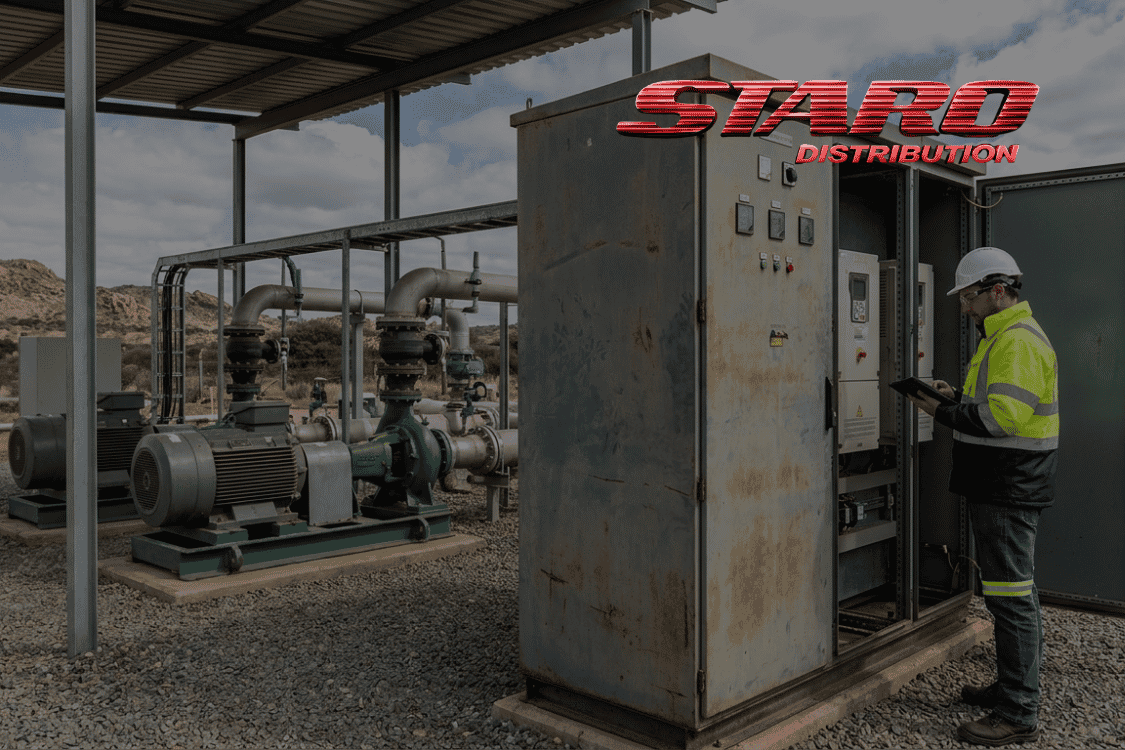

Electric motors are among the most significant energy consumers in any process plant. Pumps, fans, conveyors, compressors, and mixers often operate for thousands of hours every year, making industrial motor control a crucial pillar of any plant’s energy-efficiency strategy.
The challenge is that process demand is rarely constant. A pump may not require maximum flow throughout every production cycle, and a fan may only need full airflow during peak conditions. When a motor continues operating at full speed regardless of actual process demand, that surplus output is wasted electrical energy — and across thousands of running hours a year, it adds up.
Variable Frequency Drives (VFDs) allow plants to match motor performance to what the process actually requires. For mining, manufacturing, mineral processing, and petrochemical operations, this creates an opportunity to reduce electricity consumption while simultaneously improving process control.
Quick Answer: How Do VFDs Improve Energy Efficiency?
Variable frequency drives (VFDs) improve energy efficiency by matching motor speed and torque to actual process demand instead of running motors continuously at full speed. Because power demand in centrifugal pumps and fans falls roughly with the cube of speed, even modest speed reductions can produce disproportionately large savings, and removing throttling valves, dampers and other mechanical restrictions eliminates a further source of waste.
VFDs also soft-start motors, cutting the current inrush and mechanical stress of direct-on-line starting. Modern PowerFlex drives add further built-in energy functions such as Energy Pause and Economizer mode, while Staro Process Control provides the engineering, integration, and lifecycle support required to apply this VFD technology effectively in South Africa.
Addressing Energy Waste at the Source
A standard AC motor connected directly to the electrical supply operates at a fixed speed determined by the supply frequency. Traditionally, plants regulate flow using throttling valves, dampers, bypass systems, or other mechanical flow restrictions.
While these methods do restrict the process, the motor itself keeps consuming energy to produce output the process doesn’t need — the restriction happens mechanically, after the fact.
A correctly engineered VFD system removes the mechanical restriction and addresses energy use at its source: the motor speed itself. By varying the frequency and voltage supplied to the motor, the drive lets the equipment deliver exactly the required output — and nothing more.
The Affinity Laws: Significant Savings for Pumps and Fans
Centrifugal pumps and fans offer the strongest VFD energy-saving opportunities.
Under suitable system conditions, these applications follow the affinity laws, which state that motor power demand changes approximately with the cube of speed. A modest reduction in speed can therefore produce a much larger reduction in power demand: cutting the speed of a suitable pump or fan by around 10% can reduce its power requirement by close to 27% (ABB Group).
This is why plants should look beyond the efficiency rating of individual components and evaluate how much energy the entire motor-driven system consumes while performing its required duty.
Efficiency Follows Process Demand
A VFD delivers its biggest benefit when it’s part of an intelligently controlled process, not a fixed-speed replacement. Linked to plant instrumentation and the automation system, a drive can continuously adjust motor speed against real variables — flow, pressure, temperature, or production throughput — instead of a preset target.
A cooling-water pump is a typical example: rather than running at full output throughout production, its speed can track the actual temperature of the cooling circuit in real time. This connects directly to our guide on Industrial Energy Management, where energy data becomes far more valuable once it can actively influence plant operation.
Soft Starting: Lower Inrush Current, Less Mechanical Stress
Energy efficiency isn’t the only benefit. A motor started direct-on-line draws a large current spike — often several times its running current — the moment it’s switched on. A VFD instead ramps the motor up and down gradually.
This soft-start capability:
- Reduces peak current draw at startup, which can also help manage the demand-charge component of an industrial electricity tariff, not just kWh consumption
- Lowers mechanical shock on motors, bearings, couplings, belts, gearboxes, and connected process piping
- Reduces stress on connected pumps and conveyors, supporting longer service intervals
Rockwell Automation’s smart motor-control approach similarly links motor control with diagnostic and operational data to support maintenance decisions and total cost of ownership (Rockwell Automation). An appropriately engineered VFD application therefore improves energy efficiency, process stability, and equipment lifespan at the same time.
Modern VFDs Provide Advanced Energy Functions
Modern drive technology offers far more than basic speed adjustment. The Allen-Bradley PowerFlex® portfolio, available through Staro Process Control, includes drive technologies designed for specific industrial motor-control requirements.
For example, high-performance PowerFlex 755TS drives include built-in energy-related functionality such as:
- Energy Pause: Places the drive into a lower-energy state when the process is temporarily halted.
- Economizer Mode: Intelligently adjusts drive output voltage according to motor load under suitable operating conditions to save power.
A drive should never be selected simply for its advanced features, however — it must suit the motor, the load profile, and the wider control architecture. (Explore this broader engineering approach in our article on PowerFlex Drives for Industrial Motor Control.)
How to Identify and Measure VFD Opportunities
There is no universal “percentage saved” that can be promised for every VFD installation. Savings depend on existing motor conditions, process load profile, operating hours, the current control method, and electricity tariffs, among other factors.
To identify high-ROI opportunities, target motors that:
- Run for long periods or start and stop frequently
- Operate at partial process demand for much of their cycle
- Use throttling, dampers, or other mechanical restrictions for control
- Drive centrifugal pumps or fans
- Have highly variable production loads
- Were oversized for the duty they now perform
Before implementing a project, plants should establish a baseline of how the existing system operates — that’s what makes it possible to prioritise the applications where a VFD will provide a meaningful operational and financial return.
Staro Process Control: Engineering Smarter Motor Control
Selecting an energy-efficient drive is only one part of the project — it also has to integrate correctly into the existing process environment.
As an authorised Rockwell Automation Value-Add Distributor, Staro Process Control provides the engineering expertise, product access, and integration capability required to develop complete motor-control solutions: assessing motor requirements and control philosophy, handling PLC integration and commissioning, and planning for future lifecycle needs — so energy efficiency never comes at the expense of process reliability.
Ready to optimise your plant’s energy consumption? Contact Staro Process Control to assess your industrial motor-control strategy today.
Frequently Asked Questions (FAQs)
1. How do VFDs improve energy efficiency in process plants?
VFDs control the frequency and voltage supplied to electric motors, allowing motor speed to follow actual process demand dynamically. This prevents motors from continuously operating at full speed and wasting energy when a lower output is sufficient.
2. Which process plant equipment benefits most from VFD control?
Centrifugal pumps and fans often provide the highest return on investment because their power requirements fall exponentially when speed is reduced (due to the affinity laws). Compressors, conveyors, and mixers also benefit, depending on their operating requirements.
3. Do VFDs reduce equipment wear as well as energy costs?
Yes. Soft starting lowers the inrush current and mechanical shock of direct-on-line starts, reducing stress on motors, bearings, couplings, and connected equipment.
4. How much energy can a VFD save?
There is no single saving applicable to every installation. Savings depend on the motor, load profile, operating hours, existing control method, and process requirements. A proper plant energy assessment should be completed before calculating potential financial returns.
5. Can Staro Process Control assess existing motors for VFD opportunities?
Yes. Staro Process Control evaluates your existing motors, drive requirements, process conditions, and automation architecture to pinpoint exactly where variable-speed control will yield the best efficiency and overall plant performance improvements.
6. Does Staro supply Allen-Bradley PowerFlex VFDs in South Africa?
Yes. Staro Process Control is an authorised Rockwell Automation Value-Add Distributor. We provide genuine Allen-Bradley PowerFlex drive solutions alongside expert engineering, integration, commissioning, and lifecycle support.




BUSINESS UNITS
Process Control Systems (PCS)
- Programmable Logic Controllers (PLC’s)
- Visualization (HMI and SCADA Systems)
- Software Standards (Abnormal Situation Management)
- Data Historian
- Remote Operating Centres
- Safety Control Systems
Electrical Systems (ES)
- Distribution and Motor Control Centres (MCC’s)
- Intelligent Motor Control
- Advanced Variable Speed Drive Systems
Industrial Information
& Communication
Technology (IICT)
- Industrial Ethernet Networks
- Remote Connectivity
- Cyber Security
- IT Virtualisation
- Manufacturing Execution Systems (MES)
- CMMS
We offer peace of mind project execution knowing that our activities are accredited by ISO9001:2015 Certification and a 5 star NOSA safety certification. This ensures that we maintain a high level of quality assurance and adhere to rigorous Occupational Health and Safety standards during project delivery.

SERVICES
Professional services include each phase of the project lifecycle:
Project management
STARO Integration manages every project with a comprehensive set of tools based on the PMBOK Project Management Standards.
Basic design
STARO Integration has over 25 years’ experience and our experienced engineering team works closely with the customer to understand the initial scope of work for a project and propose a high-level view of the system requirements.
Detailed hardware design
STARO Integration performs the Detailed Hardware Design in line with industry-, OEM- and Quality standards combined with our 25 years of industry knowledge. This is done with continuous client reviews and approval cycles.
Detailed software design
STARO Integration utilise our inhouse software standards as a baseline and with the client determine the standards to be utilised. The Control System Software is then developed utilizing these proven Software standards resulting in a consistent, correct, maintainable control system.
Design drawings
STARO Integration provides Design and Drawing services for instrumentation, field devices and electrical equipment. These drawings including layout, installation, wiring, junction boxes, and cable routing.
Network design
STARO Integration designs according to industry standards as well as vendor specific networks for distributing controllers, I/O, data servers, and operator stations.
Simulation and Factory Acceptance Testing
a FAT plan with checklists tests every loop and HMI/SCADA screen against the Software Design Specification. Quality of workmanship is reviewed against the Quality Assurance check sheets and a punch list of items are resolved before shipping the system.
Site Acceptance Testing and Start-up
After the control system and all the I/O have been installed and commissioned, STARO Integration works with the client to supply the Site Acceptance Testing in accordance with the SAT plan. Site Acceptance Testing proves that the supplied system, including the control logic and operator stations, is interfaced to the field I/O correctly and performs in accordance with the functional design specification.
Training services
STARO Integration can offer either OEM specific training or training specific to a control system project.
Maintenance and support
STARO Integration offers qualified engineers to support the customers installed Control System.
A Service Level Agreement (SLA) makes pre-designated engineers available for pre-planned work or for short notice call outs.
Lifecycle management
STARO Integration can provide the client with strategies, alternatives, and estimates for upgrades and migrations.
Download documents
Download documents

HEAD OFFICE

17 Venus Street, Sasolburg, 1947

+27 (0)16 971 3333
SECUNDA BRANCH
16 Steenkamp Street, Secunda, 2302
+27 (0)17 634 7011

sales@staro.co.za
PROUDLY DESIGNED AND BUILT BY BUNNYPANTS GRAPHIC & WEB DESIGN STUDIO | 2023


