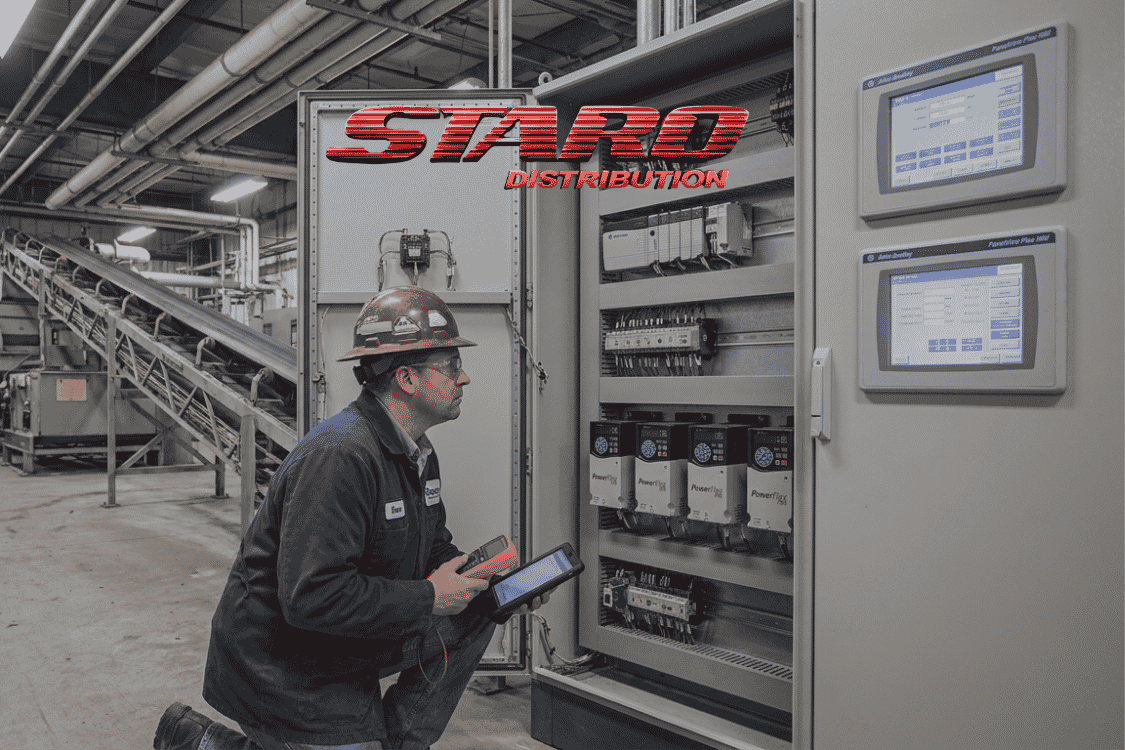

In mining, manufacturing and heavy industry, downtime is costly. When a PLC fails, a drive trips, an HMI loses communication or a critical control component is unavailable, production can stop quickly.
This is why local Rockwell Automation support matters.
For industrial plants, uptime does not only depend on the product brand installed on site. It also depends on how quickly the correct product can be supplied, how accurately it is specified and whether the local support partner understands the plant environment.
Staro Process Control supports this need through authorised Rockwell Automation distribution services, Allen-Bradley product supply and practical industrial automation support. For South African plants, this means access to genuine automation products, technical product guidance and local service capability when uptime is under pressure.
Uptime Starts with Local Distribution
A plant cannot recover quickly if the correct replacement part is delayed, incorrectly specified or sourced through an unreliable channel.
This is where Staro’s distribution role becomes important.
As a local Rockwell Automation and Allen-Bradley distribution partner, Staro helps industrial clients source the correct automation products for maintenance, upgrades and project work. This includes products used in PLC systems, HMI platforms, PowerFlex drive applications, MCCs, industrial networks, safety systems and low-voltage control environments.
For procurement teams and engineers, this reduces risk. For maintenance teams, it supports faster repair decisions. For production teams, it helps protect uptime.
Why Authorised Supply Matters
In heavy industry, not every replacement component is equal. A wrong part number, unsupported firmware level or unsuitable alternative can create further downtime.
Working with an authorised distribution partner helps ensure:
- Genuine Rockwell Automation and Allen-Bradley products
- Correct product selection
- Better compatibility guidance
- Product lifecycle support
- Safer replacement decisions
- Access to manufacturer-aligned product information
- Reduced risk from incorrect or grey-market supply
For plants operating in demanding environments, this matters. The right product must not only be available; it must also fit the installed system correctly.
Staro’s Allen-Bradley Product Support
Staro Process Control supports industrial clients with Allen-Bradley and Rockwell Automation product supply for both planned projects and urgent maintenance needs.
This may include:
- Allen-Bradley PLCs
- ControlLogix and CompactLogix platforms
- Remote I/O systems
- HMI and operator interface products
- PowerFlex variable speed drives
- Soft starters
- Motor control products
- MCC-related components
- Safety control products
- Industrial network hardware
- Power monitoring and control gear
This distribution capability allows Staro to support a wide range of plant requirements, from replacement components to larger automation upgrade projects.
Local Support Reduces Downtime Risk
Downtime is rarely caused by one simple issue. A PowerFlex drive fault may relate to the motor, MCC, process load, control signal or network. A PLC fault may involve I/O, firmware, field wiring, power supply or communication problems.
Because Staro understands both product supply and industrial automation applications, the company can help clients make better support decisions.
Instead of simply replacing parts, Staro can assist with questions such as:
- Is this the correct replacement product?
- Is the current product still supported?
- Is there a newer equivalent available?
- Will the replacement work with the existing PLC or HMI?
- Is a migration required?
- Should the plant keep this item as a critical spare?
This practical product knowledge helps reduce guesswork during breakdowns and shutdown work.
PLC, HMI and Drive Support Where It Matters
Allen-Bradley PLCs, HMIs and drives are often central to plant uptime. When any of these systems fail or become obsolete, the effect can be immediate.
Staro’s local distribution and support can assist with:
PLC support: product selection, replacement modules, ControlLogix and CompactLogix components, remote I/O, communication modules and lifecycle planning.
HMI support: PanelView products, operator interface replacement, HMI upgrade planning and compatibility guidance.
Drive support: PowerFlex drive supply, replacement guidance, drive sizing discussions, motor control support and MCC integration.
For industrial clients, the value is not only in getting a quote. The value is in receiving informed product support from a company that understands demanding plant environments.
Support for Projects, Maintenance and Upgrades
Local Rockwell Automation distribution is important during both breakdowns and planned work.
For maintenance teams, Staro can support replacement product sourcing and spares planning. For project teams, Staro can assist with product selection for new installations, expansions and shutdown projects. For engineering teams, Staro can help identify lifecycle risks and plan migrations from older automation platforms.
This is especially useful when plants need to manage:
- PLC upgrades
- HMI replacements
- PowerFlex drive changes
- MCC modernisation
- Remote I/O expansion
- Industrial network improvements
- Critical spares lists
- Obsolete product replacement
- Shutdown-based project supply
By planning these requirements with a local authorised partner, plants reduce the risk of delays when production windows are limited.
Lifecycle Planning Protects Uptime
One of the biggest downtime risks is waiting until a product fails before checking whether it is still available or supported.
Staro helps clients think beyond emergency replacement. Lifecycle planning allows plants to identify which PLCs, HMIs, drives and control components are current, which are nearing end-of-life and which should be included in future upgrade planning.
This helps plants:
- Build better spares lists
- Avoid urgent procurement pressure
- Plan upgrades before failure
- Reduce shutdown risk
- Improve budget planning
- Keep control systems supportable
For uptime-focused plants, lifecycle planning is not optional. It is part of long-term operational reliability.
Distribution Backed by Technical Capability
Staro’s strength is that its distribution service is supported by technical understanding.
Many suppliers can quote a catalogue number. Staro adds value by understanding how Rockwell Automation and Allen-Bradley products fit into PLC systems, HMI platforms, drive applications, MCCs, electrical systems and industrial networks.
This makes Staro a stronger partner for plants that need more than product supply. Clients can rely on Staro for authorised distribution, product guidance, integration experience, lifecycle support and local service capability.
FAQs
Why does local Rockwell Automation support improve plant uptime?
Local Rockwell Automation support improves uptime because engineers can respond faster, understand the installed plant architecture and diagnose faults in context. This helps reduce Mean Time to Repair for PLC, HMI, drive, MCC and industrial network issues.
Who provides local Rockwell Automation and Allen-Bradley support in South Africa?
Staro Process Control provides local Rockwell Automation and Allen-Bradley support for industrial clients in South Africa. The company supports product supply, system integration, PLCs, HMIs, drives, MCCs, industrial ICT, testing, commissioning and lifecycle services.
How does local support reduce downtime during Allen-Bradley PLC and drive faults?
Local support reduces downtime by helping teams identify whether the fault sits in the PLC, HMI, PowerFlex drive, MCC, industrial network, motor or process load. This prevents unnecessary component changes and helps restore production safely.
Can Staro support Rockwell Automation upgrades and migrations?
Yes. Staro can support Rockwell Automation upgrades and migrations through planning, compatibility checks, PLC and HMI backups, drive parameter review, FAT testing, SAT testing and phased implementation to reduce production disruption.
Why is local support better than relying only on remote or online troubleshooting?
Remote and online support is useful for documentation, downloads and general technical guidance, but local support adds site-specific knowledge. A local team can understand the plant layout, equipment history, operating risks and urgency, making the troubleshooting process more practical and faster.



BUSINESS UNITS
Process Control Systems (PCS)
- Programmable Logic Controllers (PLC’s)
- Visualization (HMI and SCADA Systems)
- Software Standards (Abnormal Situation Management)
- Data Historian
- Remote Operating Centres
- Safety Control Systems
Electrical Systems (ES)
- Distribution and Motor Control Centres (MCC’s)
- Intelligent Motor Control
- Advanced Variable Speed Drive Systems
Industrial Information
& Communication
Technology (IICT)
- Industrial Ethernet Networks
- Remote Connectivity
- Cyber Security
- IT Virtualisation
- Manufacturing Execution Systems (MES)
- CMMS
We offer peace of mind project execution knowing that our activities are accredited by ISO9001:2015 Certification and a 5 star NOSA safety certification. This ensures that we maintain a high level of quality assurance and adhere to rigorous Occupational Health and Safety standards during project delivery.

SERVICES
Professional services include each phase of the project lifecycle:
Project management
STARO Integration manages every project with a comprehensive set of tools based on the PMBOK Project Management Standards.
Basic design
STARO Integration has over 25 years’ experience and our experienced engineering team works closely with the customer to understand the initial scope of work for a project and propose a high-level view of the system requirements.
Detailed hardware design
STARO Integration performs the Detailed Hardware Design in line with industry-, OEM- and Quality standards combined with our 25 years of industry knowledge. This is done with continuous client reviews and approval cycles.
Detailed software design
STARO Integration utilise our inhouse software standards as a baseline and with the client determine the standards to be utilised. The Control System Software is then developed utilizing these proven Software standards resulting in a consistent, correct, maintainable control system.
Design drawings
STARO Integration provides Design and Drawing services for instrumentation, field devices and electrical equipment. These drawings including layout, installation, wiring, junction boxes, and cable routing.
Network design
STARO Integration designs according to industry standards as well as vendor specific networks for distributing controllers, I/O, data servers, and operator stations.
Simulation and Factory Acceptance Testing
a FAT plan with checklists tests every loop and HMI/SCADA screen against the Software Design Specification. Quality of workmanship is reviewed against the Quality Assurance check sheets and a punch list of items are resolved before shipping the system.
Site Acceptance Testing and Start-up
After the control system and all the I/O have been installed and commissioned, STARO Integration works with the client to supply the Site Acceptance Testing in accordance with the SAT plan. Site Acceptance Testing proves that the supplied system, including the control logic and operator stations, is interfaced to the field I/O correctly and performs in accordance with the functional design specification.
Training services
STARO Integration can offer either OEM specific training or training specific to a control system project.
Maintenance and support
STARO Integration offers qualified engineers to support the customers installed Control System.
A Service Level Agreement (SLA) makes pre-designated engineers available for pre-planned work or for short notice call outs.
Lifecycle management
STARO Integration can provide the client with strategies, alternatives, and estimates for upgrades and migrations.
Download documents
Download documents

HEAD OFFICE

17 Venus Street, Sasolburg, 1947

+27 (0)16 971 3333
SECUNDA BRANCH
16 Steenkamp Street, Secunda, 2302
+27 (0)17 634 7011

sales@staro.co.za
PROUDLY DESIGNED AND BUILT BY BUNNYPANTS GRAPHIC & WEB DESIGN STUDIO | 2023


